
funnest places to visit in the us: Six Natural Wonders of the World
1. Grand Canyon: Located on the Kaibab Plateau in northwestern Arizona in the western United States, it was formed by the Colorado River after millions of years of erosion. The Grand Canyon is 446 kilometers long, with an average width of 16 kilometers, a maximum depth of 1,740 meters, and a total area of 2,724 square kilometers. The climate and landscape of the canyon walls and bottom vary greatly, with the south wall being dry and warm, the north wall cold and humid, and the bottom dry and hot. Its rock layers are clear, containing fossils of different eras. It is a natural heritage protected by UNESCO and also a famous tourist destination.
Americans have always taken pride in the western Grand Canyon. A president once said: Anyone who comes to the United States must see the western Grand Canyon, otherwise they cannot be considered to have visited America. Its vast and magnificent spirit, and its spectacular and stunning scenery, are unparalleled in the world.


2. Glacier Bay, Alaska: Located in Alaska, USA, 50 miles from Juneau, covering an area of 3.3 million hectares. It was formed during the Little Ice Age 4,000 years ago. Over thousands of years, the glacier continuously advanced forward and reached its peak in 1750, after which it began to melt and retreat. Glacier Bay National Park includes 18 glaciers and 12 coastal glacier landforms, with countless icebergs, making it the most concentrated place of tidal icebergs in the world. It is also home to various animals such as whales and seals. For environmental protection reasons, the local authorities strictly control the number of entering vessels.

3. Mammoth Cave: Located in Mammoth Cave National Park in central Kentucky, USA, Mammoth Cave is approximately 80 kilometers from Bowling Green, Kentucky, and is one of the World Natural Heritage sites. Mammoth Cave is named after the ancient giant woolly mammoth. As of 2006, this giant cave has an explored length of nearly 600 kilometers, and its exact length is still being explored today. It is the world’s largest natural cave system and underground passage composed of limestone.
Mammoth Cave, covering 207.83 square kilometers in Mammoth Cave National Park, is the world’s largest limestone underground cave network. Mammoth Cave is truly a combination of beauty and wonder. The underground chambers follow one after another, possessing many incredible and strange sights: conical stalactites and stalagmites, thick stone waterfalls, banded crystals, slender stone pillars, and flute-like stone shields. Hikers will find themselves wandering through a vast, expansive space, surrounded by underground lakes and canyons, waterfalls and streams, narrow corridors, and arched domes.

4. Mount Everest: In Tibetan, it means ‘Mother of the Earth’, it is the main peak of the Himalayas and also the highest peak in the world. Its rock surface elevation is 8844.43 meters, and its snow surface elevation is 8848.86 meters. It is located on the border between the People’s Republic of China and Nepal, at 86.9° east longitude and 27.9° north latitude.
Mount Everest is located in the middle section of the Himalayas. The mountain body is in the shape of a giant pyramid with extremely rugged terrain. The snow line height is 5800-6200 meters on the northern slope and 5500-6100 meters on the southern slope. Between the northeast ridge, southeast ridge, and west ridge are three steep walls (north wall, east wall, and southwest wall). Between these ridges and cliffs, there are 548 continental-type glaciers, covering a total area of 1457.07 square kilometers, with an average thickness of 7260 meters.
The climate differs significantly between the northern and southern slopes of Mount Everest. At an altitude of 7500 meters, the average temperature on the northern slope is -27.1°C in February and -10.4°C in August, with an annual average temperature of -19.6°C. The temperature on the southern slope is relatively higher. In addition, the wind in the Mount Everest area is strong, especially in winter when snowstorms are frequent.
Mount Everest has magnificent natural landscapes and a unique ecosystem, serving as a habitat for many rare plants and animals. However, due to its remote geographical location and harsh climate, Mount Everest’s ecological environment also faces numerous challenges, such as climate change, glacier retreat, and human activities.
In the history of mountaineering, Mount Everest has always been a place of yearning for mountaineers and scientists. Since the early 19th century, numerous mountaineering teams have attempted to climb Mount Everest, but it wasn’t until 1953 that New Zealander Edmund Hillary and Tenzing successfully reached the summit, ushering in a new era of human climbing of Mount Everest. Since then, Mount Everest has attracted more and more climbers to challenge it, and thousands of people have successfully reached the summit to date.

5. Lake Baikal: Located in southern Siberia, Russia, it is one of the oldest and deepest freshwater lakes in the world, known as the “ecological miracle”,
Lake Baikal is not only famous for its depth of 1642 meters, but also renowned for its clear lake water and unique ecosystem. With a transparency of up to 40.5 meters, the lake contains about 1200 species of aquatic animals, such as Baikal sturgeon and freshwater seals, and about 600 species of plants, including rare animals like seals. It was listed as a World Heritage Site in 1996.
This place is also one of the birthplaces of Shamanism, where the legendary ‘spirit of water’ resides. Ancient rituals and mysterious culture continue to this day, adding a sense of sacredness and tranquility to this land.

6. Yellowstone National Park: Located at the junction of Wyoming, Montana, and Idaho in the Midwestern United States, it is the world’s first nationally recognized park established by the government.
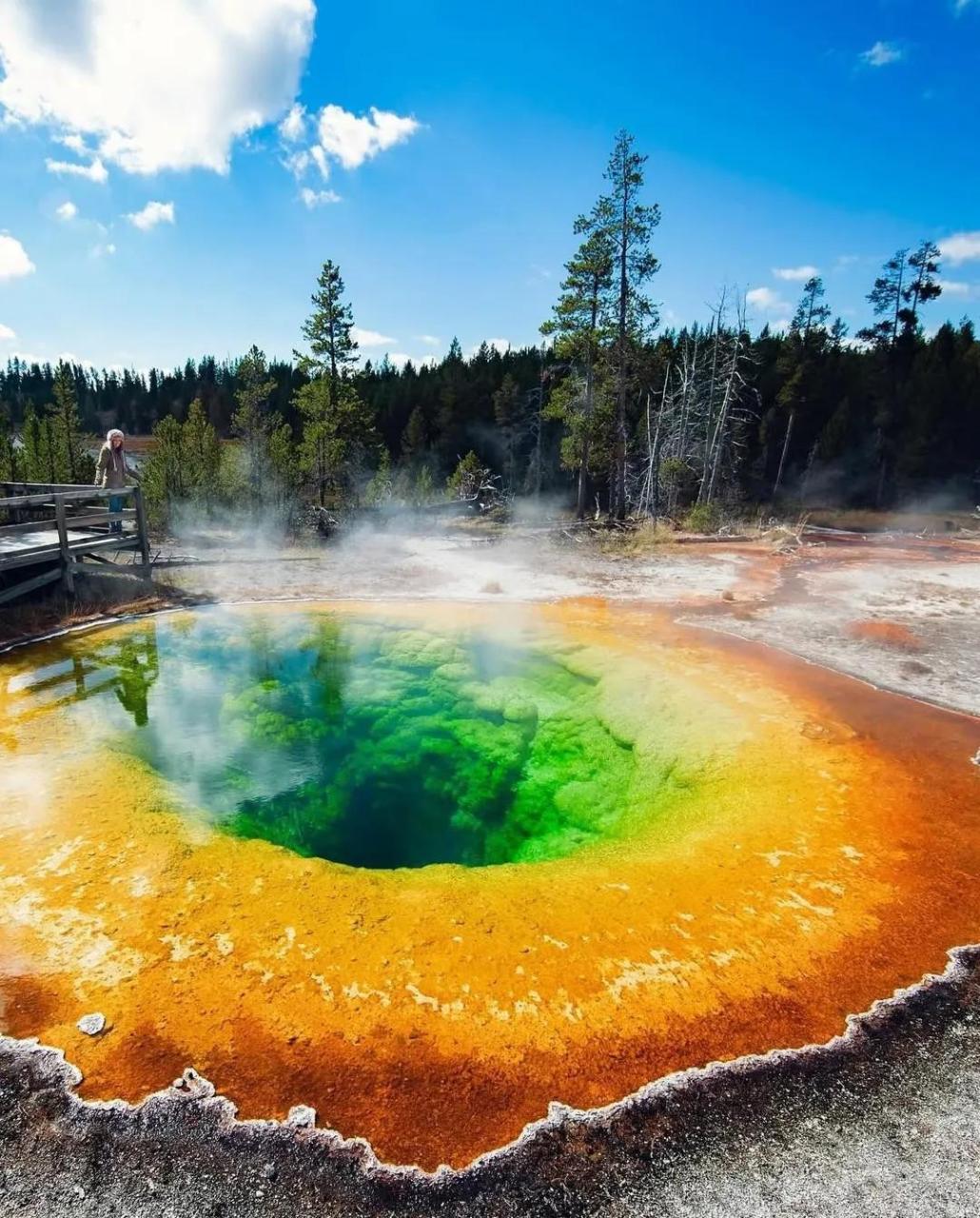
The park covers 3,500 square miles (~9,000 square kilometers) and includes lakes, canyons, rivers, mountains, and the world’s largest geothermal resources. The geothermal landscapes are so numerous, extensive, rich, colorful, and active that any single feature would rank first in the world.
Yellowstone has approximately 10,000 geothermal features of various sizes, including more than 500 geysers. One park concentrates two-thirds of the world’s geothermal features and more than half of the active geysers.
The park is situated on a volcanic caldera formed by a volcanic eruption 640,000 years ago, and its geothermal features originate from the enormous magma chamber beneath it. Simply put, the superheat that needs to be released from within the still-active underground volcano provides the thermal energy, rain and snow provide water, and the pathways from underground to the surface serve as conduits. Together, these elements create five typical types of geothermal landscapes.
If reprinted, please indicate the source:https://bali123.com/travel-blogs/funnest-places-to-visit-in-the-us-six-natural-wonders-of-the-world/
Related recommendations
-
Top US Travel Destinations: 16 Amazing Places Worth Visiting in America
The United States is vast with rich and diverse tourism resources. Here are 16 great places worth visiting in the United States: New York City: As a global center of art, fashion, finance, music, and cuisine, New York City is known for its diverse culture and vibrant neighborhoods. Whether appreciating world-class artworks or tasting delicious food at local restaurants, New York can meet all your needs. New York City streets San Francisco, California: With its unique West Coast charm, San Francisco offers rich cultural experiences. You can enjoy beautiful bay views at Golden Gate Park, stroll through America’s largest and oldest Chinese community, or appreciate avant-garde art in local galleries. San Francisco Bridge National Mall in Washington, D.C.: As the center of American political life, the National Mall brings together numerous monuments and museums, including the National Museum of Natural History, the National Gallery of Art, and the Lincoln Memorial. Overview of the National Mall in Washington, D.C. New England Region: New England is famous for its charming centuries-old towns and spectacular red leaves in autumn. You can stroll through the quaint villages of Cape Cod, taste delicious lobster, or spend a quiet weekend in a mountain cabin in Vermont….
-
Chaoyang Tourist Attractions: Summer Travelogue of Chaoyang and Chifeng
In the early morning, I took the high-speed train to Chaoyang. In Northeast China, the summer sunrise is very early, with daylight appearing around 4 AM. Therefore, although I was catching a train after 7 AM, I didn’t suffer the pain of waking up early. I thus left this place again, carrying the remaining memories of my hometown. Daqing West Station Chaoyang is located in the northwestern part of Liaoning Province, named after the Chaoyang Cave on Phoenix Mountain within its territory, taking its meaning from the ‘Book of Songs’ phrase ‘phoenix singing at sunrise.’ This place was anciently known as Dragon City, serving as a hub for political, economic, and cultural exchanges between Northeast China and the Central Plains, as well as a strategic frontier location throughout various dynasties. During the ‘Wu Hu Rebellion’ period, the Xianbei Murong clan initially established Dragon City here, which later became the capital of the Three Yan dynasties. Subsequently, during the Northern Wei to Sui and Tang dynasties, it was established as Yingzhou. During the Liao and Jin dynasties, it was set up as Xingzhong Prefecture. During the Hongwu era of the Ming Dynasty, it was established as Yingzhou Guard. In the late…
-
best places to visit in usa for first time: Five must-visit tourist attractions in the USA
The United States is a vast country composed of 50 states, with an area similar to that of Europe. Here, you can enjoy stunning natural and urban landscapes, and experience diverse people and cultures. Whether it’s the tropical charm of Hawaii or the desert wonders of the Grand Canyon, whether it’s the diverse appeal of Chicago or the bustling excitement of New York, you can find a travel destination that suits you. Below are our recommended best travel destinations in the United States. #5: Aspen If you enjoy skiing, then Aspen is definitely your top choice. This small town located in Colorado has four ski areas, allowing you to fully enjoy the fun of ice and snow sports in winter. Aspen was once the silver mining capital of the late 19th century, leaving behind many buildings with historical charm. When you visit here in summer, you can also explore the beautiful natural landscapes by hiking in the nearby mountains. Number 4: Atlanta Atlanta is the capital and largest city of Georgia, and also the leader of the New South. The city is situated among rolling hills, pine forests, ancient oak trees, and magnolia trees, boasting three spectacular city skylines. Atlanta…
-
Acropolis of Athens Complete Travel Guide 2025 [Athens, Attica]: Everything You Need to Know
📋 Quick Navigation 🏛️ Acropolis of Athens Introduction & Overview 🎫 Acropolis of Athens Tickets & Prices ⏰ Acropolis of Athens Opening Hours 🎯 Acropolis of Athens Things to Do 💡 Acropolis of Athens Travel Tips 🗺️ Acropolis of Athens Nearby Attractions ❓ Acropolis of Athens Frequently Asked Questions Planning your visit to the Acropolis of Athens? This UNESCO World Heritage Site is one of the most iconic landmarks in Greece, attracting millions of visitors each year. Whether you’re interested in ancient history, architecture, or breathtaking views of Athens, this comprehensive guide covers everything you need to know about tickets, opening hours, the best time to visit, how to get there, and insider tips to make the most of your experience. 🏛️ Acropolis of Athens Introduction & Overview The Acropolis of Athens is an ancient citadel perched on a rocky outcrop above the city of Athens. Dating back to the 5th century BCE, it is home to several historically significant structures, including the Parthenon, the Erechtheion, and the Temple of Athena Nike. Built under the leadership of Pericles during Athens’ Golden Age, the Acropolis symbolizes the birth of democracy, philosophy, and classical architecture. Key highlights include: The Parthenon – Dedicated…
-
US Tourist Attractions: Avoid the crowds at these 10 US attractions, popular rural destinations are hidden American travel destinations
At the intersection of North Lumpkin Street and East Washington Street in downtown Athens, Georgia, locals are admiring the works of the ‘Hot Corner’ mural Nothing can ruin a trip faster than encountering crowds of people and falling into tourist traps. When planning vacations, many tourists consider the most popular or perennially favorite destinations, only to discover that others have the same idea. Thus, their journeys are filled with waiting in lines or searching for restaurants that offer affordable dishes for locals. However, there are many overlooked destinations within the United States that offer equally rich activities, cuisine, history, and cultural experiences—just without the crowds and high prices. To help travelers decide on their next hidden gem to visit, travel experts from Wander, a luxury vacation rental platform, have released a list of the top 10 most overlooked destinations in the United States. In May of this year, the experts analyzed data from Google searches, TripAdvisor, Instagram, and Numbeo, combined with lists from media outlets such as CNN and Yahoo, to select America’s hidden gems. Specifically, the team analyzed the number of restaurants, museums, landmarks, and other venues, as well as factors like safety and cleanliness. From the art and…
-
Paris Itinerary | A Paris Guide That Will Instantly Make You Stylish
It’s been a long time since my Paris trip, and I’ve been truly “lazy” for not sharing anything sooner. After a complete change of heart, I present to you this Paris list from the “Fashion Planet”. It’s “trendy” (and “different”) because it doesn’t specifically list attractions and itineraries. Instead, it’s a sharing of food, shopping, experiences, hotels, and accommodations to help you become a “Chic Parisian”. Well, elegance has its formula, “Bonjour, Paris!” 1. Delicious Food: A delicious list revealed by a “food expert” Being able to eat so happily in Paris is all thanks to recommendations from Sugar&Spiced (a Parisian pastry chef and food blogger, searchable on Weibo). Coincidentally, I followed her on Weibo before my trip, and she had already been living in Paris for three years. The restaurants and food I selected based on her Weibo recommendations truly didn’t disappoint – they were satisfyingly “delicious.” Let me briefly recommend a few places I tried and was very impressed with. Ha, a foodie’s world map should probably be marked with food, right? PS: There are Paris restaurant introductions on her personal website (all of which she has visited), you can find a very comprehensive list. Claus Address: 14…
-
Hot Spring Travel Guide: Tangshan Hot Spring Tourist Resort
Tangshan Hot Spring Tourist Resort is a national tourist resort in the eastern suburbs of Nanjing. Here is a travel guide: Basic Information – Transportation: You can take Metro Line S6 to Tangshan Station, then walk or transfer to a bus to reach various attractions. You can also drive there, as there are parking lots in the scenic area. – Best time to visit: September to February of the following year is more suitable, as the temperature is lower during this period, allowing you to better feel the warmth and comfort of the hot springs. Attractions – Hot Spring Experience: There are many hot spring hotels and resorts in the resort area, such as Tangshan No. 1 Hot Spring, which has various types including red wine pools, milk pools, and medicated baths. The outdoor waterfall pool is great for taking photos. Hantian · Zhen Hot Spring covers an area of 8,300㎡ and features indoor water play, a leisure hall, a children’s playground, and various themed pools. – Historical and Cultural Attractions: Yangshan Stele Material is a national 4A-level scenic area, featuring Ming Culture Village and the world’s largest Yangshan Stele Material; Tangshan Ape Cave is the only karst landscape open…
-
Places to travel in US: A Guide to America’s Beautiful National Parks
Figures 1-4 Denali National Park, Alaska Denali National Park, located in the heart of Alaska, is a nature reserve with diverse terrain and magnificent landscapes. Within the park, vast plains, lush forests, magnificent colorful mountains, and exposed granite slopes form striking contrasts. This area has become a paradise for numerous wildlife species due to its complex and varied topography. Large caribou, moose, and grizzly bears roam freely across this land, coexisting with over 650 species of flowering plants, as well as countless mosses, lichens, and fungi. The tundra and boreal forest ecosystems here exhibit unique vitality, adapting to the park’s distinct seasonal climate changes and special terrain conditions. Figures 5-8 Yosemite National Park Yosemite National Park is located on the western foothills of the Sierra Nevada in western California, USA, with the Merced River flowing through it. The park covers an area of approximately 1,100 square miles and is one of the famous nature reserves in the United States. The park spans across Mediterranean climate and alpine mountain climate regions, with its main vegetation being subtropical coniferous forests. In 1984, it was listed as a World Natural Heritage by UNESCO, and in 2006, it established a friendly park relationship with…
-
Sichuan Travel Itinerary Recommendations: Detailed Introduction and Scenery Appreciation of Top-Rated Western Sichuan Routes!
In autumn, if you want to take a top-tier scenic route in Western Sichuan, then this route basically contains the essence of Western Sichuan in autumn. From the very first day, it will blow you away with its stunning beauty. This is a challenging route, and to capture great photographs, we’ve extended the time. This allows everyone to have a truly in-depth journey through Western Sichuan. On this route in Western Sichuan, you’ll feel like you’re walking through a painting every day with its colorful forests Western Sichuan has many beautiful landscapes, and each season is completely different. If you want to see colorful forests in autumn, then Miyaluo, the 80-li gallery of Naizigou in Heishui, Bipeng Valley, Daocheng Yading, the 10-li colorful forest of Xinduqiao, and the hundreds of li along the route from Jiagenba to Moon Lake are all filled with colorful forests. When you find yourself in the midst of it all, you feel that every step reveals absolutely stunning scenery. Of course, having just colorful forests isn’t enough; the charm of Western Sichuan lies in its snow mountains, and the colorful forests are just the icing on the cake. On this route, we focus on the…
-
Indonesia Kuta Beach: Bali Independent Travel Guide and 2025 Top 10 Attractions Recommendations!
Want to travel independently to Bali, worried about language barriers, afraid of not finding places to visit, and concerned about falling into traps and wasting money, Save this latest 2025 guide, specially customized for Chinese tourists. Chinese services? Available! Chinese signs? Available! Staff who speak Chinese? Also available! The visa-free policy is still in effect, just grab your passport and you can fly, Bali’s friendliness towards Chinese tourists has visibly soared. You can visit these places without hesitation, with no communication barriers. 1. Kuta Beach A surfer’s paradise, Beginners can have fun too, Dense shops along the beach, Plenty of Chinese-speaking surf instructors, No barriers to bargaining for board rentals, “A bit cheaper?” “Sure!” Crowded at sunset, Find a beach bar, Order a Bintang beer, Watch the fiery sunset clouds. 2. Tanah Lot (Sea God Temple) Bali landmark, Built on a huge reef, Appears to float on the sea during high tide, Can only walk up to it during low tide, Chinese audio guides are available for rent at the entrance, Key signs have Chinese translations, The sunset view is amazing. 3. Ubud Art Market (Ubud Art Market) A treasure trove for handicrafts, Wood carvings, woven bags, dreamcatchers… Shopkeepers shout…