
visiting pompeii italy: The Destruction and Rebirth of Pompeii
On that day in 79 AD, the ancient city of Pompeii faced a catastrophic disaster—the eruption of Mount Vesuvius, as scorching volcanic ash and lava instantly engulfed this Roman resort. But this disaster also unexpectedly preserved Pompeii: bread was still in the bakery’s ovens, graffiti on the walls remained clearly visible, and even the final postures of people in their last moments could be seen. Today, let’s step into Pompeii to see how this city ‘frozen’ by the volcano transformed from a tragic site into an archaeological treasure, and what secrets it holds about the lives of ancient Romans ️


Until the catastrophic event of 79 AD, Pompeii was no different from other Roman resort towns.
It was located on the beautiful Bay of Naples, 14 miles (approximately 22.5 kilometers) south of the city of Naples, with luxurious villas, vineyards, and olive groves—all benefiting from the fertile volcanic soil of Mount Vesuvius.
But this active volcano soon erupted, burying the entire town under thick volcanic debris.
Ironically, the disaster that led to Pompeii’s destruction also allowed it to be preserved for centuries.
The excavation of this ‘permanently frozen’ town laid the foundation for modern archaeology.
A quirk of geography
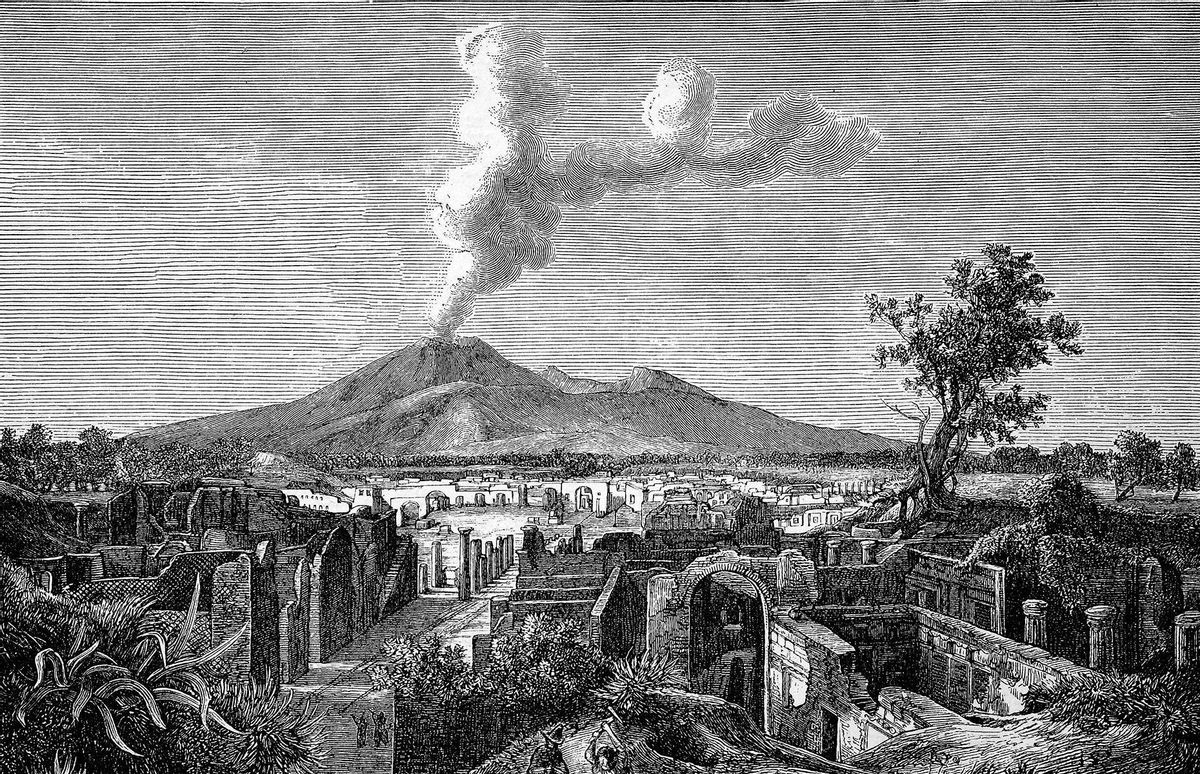
Pompeii was one of the many small towns along the southern coast of Italy, blending influences from ancient Greek and Etruscan civilizations.
The local people originally spoke Oscan, but later, as Roman influence expanded, Latin became the dominant language.
But what these ancient residents didn’t know was that the narrow strip of land where the town was located was actually formed by prehistoric lava flows.
Evidence suggests that Mount Vesuvius had erupted multiple times before, causing similar devastating consequences.
The Hamptons of ancient Rome

By the 1st century AD, in the years before the volcanic eruption, Pompeii and the nearby Herculaneum had developed into prosperous resort towns, summer retreats for the Roman elite.
Wealthy Romans built ornately decorated villas with mosaic artworks, art pieces, and elaborate fountains.
The paved streets were lined with shops, taverns, public baths—and several brothels.
The small town has a population of over 10,000, including wealthy merchants, shop owners, and slaves, forming a diverse social structure.
Gladiators, ready – for a riot

Pompeii’s amphitheater could accommodate 20,000 spectators, and the gladiatorial competitions held here attracted people from surrounding villages to watch, with the audience cheering for blood.
But the most famous incident occurred in 59 AD – a massive riot broke out between the people of Pompeii and those from nearby Nuceria.
What began as insults and taunts quickly escalated to throwing stones and drawing swords, eventually turning into a brawl.
The Roman Senate launched an investigation and punished Pompeii – banning the town from holding gladiatorial games for 10 years.
The signs were there
The devastating volcanic eruption in 79 AD was not the first natural disaster to strike Pompeii.
In 62 AD (or 63 AD, the exact date is uncertain), an earthquake occurred in the Campania region – experts now believe this was a precursor to the greater disaster to come.
In fact, the people of Pompeii had grown accustomed to the frequent earthquakes in their town, so when seismic activity intensified before the eruption, they did not see it as something to worry about.
Vesuvius erupts

On an ordinary day in 79 AD—long believed to be August 24, but recent research suggests it might have been an autumn date like October 24—the fate of Pompeii, Herculaneum, and surrounding villages was completely changed.
Pliny the Younger, a Roman writer who was in the port town of Misenum across the Bay of Naples at the time, left the only surviving eyewitness account.
He wrote that the “cloud” ejected by Mount Vesuvius was “of extraordinary size and shape”—this high-altitude column of volcanic ash is now known as a “Plinian eruption”.
People flee Pompeii in panic

As people were preparing for lunch, fine volcanic ash began to fall over Pompeii, followed by large amounts of white pumice and debris—all ejected from the crater of Mount Vesuvius and blown southward by the wind.
Some townspeople successfully escaped, carrying as many treasures, jewels, or coins as they could; others took refuge in basements as the roofs of houses began to collapse under the weight of the stones.
The danger continues

Debris continued to pile up outside the doors and windows of Pompeii’s houses, trapping the residents—volcanic ash filled the air, making it impossible to breathe.
But an even greater danger was yet to come.
In just a few hours, a fast-moving current of hot gas, lava, and toxic gases—known as a “pyroclastic flow”—erupted from the volcano, engulfing the entire town and turning it into a scorching hell.
Wave after wave of pyroclastic flows cascaded down from the fiery summit of Mount Vesuvius, with temperatures soaring above 572°F (approximately 300°C), leaving no survivors.
Desperate to escape

Later discoveries revealed many heartbreaking stories: people attempting to escape the deadly lava flows but failing, with many still clutching small amounts of silver or bronze coins, or a few of their most precious possessions, hoping to sustain themselves during their escape.
Near the city gate, a woman was discovered holding a golden statue of Mercury (the god of speed); another finding was three horses harnessed and ready to carry their owners to safety—but they had apparently waited too long and ultimately failed to escape the town.
Herculaneum was hit too

Pompeii is more famous and attracts more tourists, but its close neighbor Herculaneum was actually closer to the foot of Mount Vesuvius and suffered a similar fate.
In Herculaneum, many people tried to hide or flee to the beach for refuge, but they could not escape the superheated volcanic ash and lava flows.
Although it sounds terrifying, scientists believe that the extreme heat may have caused their blood and brain tissue to boil directly, and even transformed tissues into glass.
Darkness Descended (A darkness came)

The teenage Pliny the Younger witnessed all this from what seemed to be a safe distance, but he also fell into a panic.
At first, he and his mother stayed in Misenum, but later neighbors begged them to flee together, joining the crowds of people on the streets seeking shelter.
He later wrote in a series of letters to the Roman historian Tacitus: “We had scarcely sat down when darkness came upon us—not the darkness of a moonless or cloudy night, but as if a room had been shut up with all lights extinguished. You could hear the shrieks of women, the wailing of infants, and the shouting of men.”
The World’s Last Unending Night (One last unending night for the world)

Pliny the Younger’s eyewitness account not only gives us much information about Pompeii but also vividly shows the chaos and confusion as people scrambled to escape—they looked back at the approaching volcanic cloud, despairing of survival.
He wrote: “Some people were so afraid of death that they even prayed for death to come. Many raised their hands to pray to the gods, while more believed that the gods no longer existed, that this was the world’s last unending night.”
Pliny the Elder’s Rescue (Pliny the Elder to the rescue)

The 17-year-old Pliny the Younger stayed by his mother’s side, helping her escape, while his uncle Pliny the Elder (shown as a statue in the image) bravely ventured into the dangerous situation.
Pliny the Elder was a famous naval commander and an ally of Emperor Vespasian. He led a fleet to the town of Stabiae, attempting to rescue friends trapped there.
He successfully arrived at the town, but by the next morning, falling volcanic debris trapped him on the beach.
He was caught by volcanic toxic gases—though newer theories suggest he suddenly had a stroke or heart attack—and ultimately died.
Pompeii’s secrets laid bare

The tragic story of Pompeii was gradually forgotten, and the remains of its residents were deeply buried underground.
It was not until the late 16th century that this site was accidentally discovered when Swiss architect Domenico Fontana was laying the foundation for a building in the Sarno River valley.
Even so, it wasn’t until 1709, when another accidental discovery revealed the location of Herculaneum, that people began to connect the dots.
Within 40 years, the first excavations began, and these long-forgotten secrets gradually came to light—laying the foundation for modern archaeological research.
Treasures through time

This was not a systematic archaeological investigation, but rather a small group of explorers digging in the Campanian countryside, hoping to find ancient artifacts.
Their goal was more to find artworks or other ancient treasures to display, rather than pursuing academic research.
Spanish Army General Roque Joaquin de Alcubierre and Swiss architect Karl Weber led these sometimes chaotic excavations, through layers of rock, soil and sediment—the very materials that had hidden and almost perfectly preserved the town for centuries.
Digging for victory
The initial excavation results were not impressive, but in 1755, the “praedia of Julia Felix” was unearthed.
This vast complex included rental apartments, public baths, and beautiful gardens—with waterfalls, pools, and exquisite frescoes depicting daily life in Pompeii.
Notably, the owner of this estate was a woman, a discovery that sparked extensive discussion in academic circles.
This foreshadowed more discoveries to come, so King Charles VII of Naples issued a ban on the export of artifacts—perhaps to keep them in the Royal Palace Museum in Portici.
Up Pompeii

For many years, this site was only known as “La Civita” (meaning “the city”), because no one could determine which town or city it corresponded to—but a discovery in 1763 changed this situation.
An inscription was discovered that read: “Rei publicae Pompeianorum” (meaning “the republic of the Pompeians”), and scholars were finally able to connect this site with the tragedy of Pompey recorded in literature (including the description by Pliny the Younger).
This also put an end to some more reckless excavation methods, making people realize the importance of protecting this unique site.
Go Retro for the Romans

These discoveries caused a sensation in Western society in the 18th century, sparking renewed interest in antiquities, coinciding with the rise of neoclassical architectural style, and people also began to develop a new interest in all things ancient.
Historians believe this is directly related to the excavation of Pompeii—the exquisite villas and frescoes drove a design trend: wealthy British elites began to build rooms imitating this classical style, and architects such as Robert Adam and Sir John Soane also began to use these elements in their works.
庞贝启发艺术家(Pompeii inspires artists)

The eruption of Mount Vesuvius inspired countless artistic works that recreate the dramatic scenes of Pompeii’s destruction—though with varying degrees of accuracy.
These works both catered to the public’s interest in this tragic story and further sustained that interest.
Among them were French artist Pierre-Jacques Volaire and British painter Joseph Wright of Derby, who created more than 30 works with Pompeii as their theme, one of which is shown in the picture, titled “A View of Vesuvius from Posillipo, Naples”.
Becoming a tourist hotspot
The continued interest in Pompeii made it a stop on the “Grand Tour”—a rite-of-passage European journey for young people from the upper classes of countries like Britain, who also became the first tourists to visit these ancient ruins.
Unlike Rome’s magnificent architecture, the ongoing excavations of Pompeii revealed details of daily life—from the unfinished bread in bakery ovens to the graffiti still clearly visible on the walls—making it later become the world’s first open-air museum.
年轻的新锐考古学家(A young upstart archaeologist)

Much of what we know about Pompeii is thanks to the efforts of Italian archaeologist Giuseppe Fiorelli.
He took over the site in the 19th century and developed groundbreaking new techniques.
One of Pompeii’s most iconic symbols is a series of plaster casts that recreate the victims’ final moments—this was precisely Fiorelli’s achievement.
He discovered voids in the dense shell formed by volcanic ash and rock, inferring that these voids were left behind after organic matter decayed.
By pouring plaster of Paris into the voids and then carefully removing the surrounding volcanic ash, he recreated the facial expressions, clothing, and final poses of the Pompeians in heartbreaking detail.
Must-see attractions in Pompeii (What to see in Pompeii)

After decades of excavation, most of Pompeii’s key landmarks have been unveiled—including the magnificent amphitheater, which is one of the oldest surviving amphitheaters.
For many years, countless gladiatorial competitions were held here, and the walls still bear traces of paint from posters that once advertised these events or highlighted certain participants (the celebrities and sports stars of that time).
The forum is also a must-see attraction.
This enormous square was once the center of public life, where people shopped, visited temples dedicated to Apollo, Venus, and Jupiter, and chatted about the latest gossip.
Who lives in a house like this?
In addition to public buildings, there are many private homes and villas to visit here, giving us a deeper understanding of the lives of the Roman elite.
Highlights include the “House of the Small Fountain” – which features a beautiful fountain decorated with mosaics in its garden; and the “House of the Faun” – named after a bronze statue of a dancing faun in its entrance hall (the building now contains a replica, with the original housed in the National Archaeological Museum of Naples).
Some things never change

When exploring Pompeii, the most peculiar feeling is discovering the similarities between ancient and modern behaviors—after nearly 2000 years, human living habits haven’t changed much.
At the entrance of the “House of the Tragic Poet”, a mosaic pattern reads “cave canem” (meaning “beware of the dog”), and such warnings can be seen in many places in Pompeii, identical to the “beware of dog” signs at doorsteps today.
Many walls are also carved with graffiti, some showing off romantic histories, some looking for stolen items, and some particularly life-like: “On April 19th, I baked bread”—just like posts on modern social media sharing sourdough bread making…
庞贝入选世界遗产(Pompeii earns UNESCO status)

For centuries, the whole world has recognized the cultural value of the ancient ruins of Pompeii. In 1997, Pompeii, along with nearby Herculaneum and the Villa Oplontis ruins in the modern town of Torre Annunziata, were inscribed on the UNESCO World Heritage List.
If reprinted, please indicate the source:https://bali123.com/travel-blogs/visiting-pompeii-italy-the-destruction-and-rebirth-of-pompeii/
Related recommendations
-
must visit us: 5 Must-Visit Popular Attractions in America
Do you know which attractions to visit when traveling to the United States? If you haven’t been there yet, save these 5 must-visit popular attractions in the US right away, each one is a classic. Come follow along as we take a look~ 01 Statue of Liberty Statue of Liberty One of the must-visit attractions when traveling to the US: The Statue of Liberty is located on Liberty Island near New York City and is an important tourist attraction and landmark in the United States. For the United States, a nation of immigrants, the Statue of Liberty is a symbol of America, a symbol of the friendship between the American people and the French people, expressing the lofty ideals of the American people in striving for democracy and freedom. It is an iconic building in New York. 02 Yellowstone National Park Yellowstone National Park Yellowstone National Park covers nearly 3,500 square miles, primarily located in Wyoming, and is one of the most stunningly unique national parks in the world. Here there are various kinds of wild animals and plants (many of which are endangered), vast natural forests, numerous waterfalls, about half of the world’s geothermal features, and two-thirds of the…
-
top cities to visit in the us: Impressions of Manhattan, New York (illustrated)
The final leg of my North America tour was to visit Manhattan, New York, USA. On November 21, 2015, at 9:00 AM Eastern Time in New York, the team left the New York For your Safety Hotel where we were staying and began the final itinerary. That day, we would have a full day of sightseeing in Manhattan, New York. Manhattan, New York (Photography: Feng Ganyong) Located in the northeastern part of the East Coast of the United States, New York is the core of the New York metropolitan area, the most populous city in the United States, and one of the largest cities in the world. It is also a multi-ethnic and diverse city with immigrants from 97 countries and regions, and 800 languages spoken here. As of 2012, New York had a population of approximately 8 million people living on 789 square kilometers of land. Manhattan Architectural Landscape (Photography: Feng Ganyong) Manhattan is the most densely populated of the 5 boroughs of New York City, and also the smallest borough. Manhattan is mainly composed of a small island that is narrow east-west and long north-south, and is surrounded by the East River, Hudson River, and Harlem River. Bridge…
-
Wuhu Travel Guide: 2025 Complete Guide to Wuhu’s 8 Must-Visit Hidden Gems – Fireworks Ancient Town × Cliff Walkway × Vast Flower Fields
Wuhu As the “Pearl of the Wanjiang” in the middle and lower reaches of the Yangtze River, Wuhu is far more than just a transportation hub in the Yangtze River Delta—it also hides stunning natural and cultural wonders. After 3 years of deep involvement in the cultural tourism field and visiting more than 30 attractions in person, I’ve compiled this most comprehensive Wuhu travel guide on the internet—avoiding crowds, discovering niche spots, and balancing family-friendly and in-depth travel, to help you unlock secret places that even locals find amazing! Wuhu I. The Pinnacle of Theme Parks: A 24-Hour Carnival of Screams and Childlike Fun ① Immersive Check-in at Fantawild’s Four Parks Wuhu’s reputation as the “Capital of Chinese Theme Parks” is well-deserved! The four parks each have their unique features: Fangte Oriental Heritage (Recommendation Index ★★★★★): Reviving “The Cowherd and the Weaver Girl” and “Legend of the White Snake” with holographic projections, riding a track car through Dunhuang murals, even a 60-year-old aunt exclaimed “The traditional Chinese high-tech is so amazing”. Oriental Mythology Fantasy Kingdom (First choice for night tour): The 8 PM castle fireworks show is known as the “East China Disney alternative,” and the live-action flood effects in…
-
The Louvre Complete Travel Guide: Ticket Prices, Opening Hours & Transportation [Paris, Île-de-France]
📋 Quick Navigation 🏛️ Introduction & Overview 📸 Main Attractions & Highlights ℹ️ Practical Information 🗺️ Nearby Attractions & Food 💡 Travel Tips & Recommendations Introduction & Overview Welcome to the ultimate The Louvre travel guide, your comprehensive resource for exploring the world’s largest and most visited art museum. Located in the heart of Paris, France, The Louvre is a historic monument that houses over 38,000 artworks spanning from ancient civilizations to the 19th century. Originally built as a fortress in the late 12th century, it was transformed into a royal palace before becoming a public museum in 1793. The Louvre’s iconic glass pyramid, designed by architect I.M. Pei, serves as the main entrance and symbolizes the fusion of classical and modern architecture. Inside, visitors can marvel at legendary masterpieces like the Mona Lisa, Venus de Milo, and The Winged Victory of Samothrace, alongside countless other treasures. Whether you’re an art enthusiast, history buff, or first-time visitor, this guide will help you navigate The Louvre efficiently, ensuring you make the most of your visit. Main Attractions & Highlights The Louvre’s vast collection is divided into eight departments, each showcasing different periods and styles. Here are the must-see highlights: 1….
-
Petra Complete Travel Guide: Ticket Prices, Opening Hours & Transportation [Ma’an Governorate, Ma’an]
📋 Quick Navigation 🏛️ Introduction & Overview 📸 Main Attractions & Highlights ℹ️ Practical Information 🗺️ Nearby Attractions & Food 💡 Travel Tips & Recommendations Introduction & Overview Welcome to the ultimate Petra travel guide, your key to unlocking the mysteries of Jordan’s legendary “Rose City.” A UNESCO World Heritage Site and one of the New Seven Wonders of the World, Petra is an archaeological marvel carved into pink sandstone cliffs by the Nabataeans over 2,000 years ago. This ancient city, hidden in the rugged desert canyons of southern Jordan, offers breathtaking sights, rich history, and unforgettable adventures. Petra was once a thriving trade hub, connecting Arabia, Egypt, and the Mediterranean. Today, it captivates visitors with its intricate rock-cut architecture, including the iconic Treasury (Al-Khazneh), the Monastery (Ad-Deir), and countless tombs and temples. Whether you’re a history buff, an adventure seeker, or a photography enthusiast, Petra promises an experience like no other. Main Attractions & Highlights 1. The Treasury (Al-Khazneh) The most famous landmark in Petra, the Treasury, greets visitors at the end of the dramatic Siq (a narrow gorge). This 40-meter-high facade, adorned with intricate carvings, was believed to hold hidden treasures—though it’s actually a royal tomb. Arrive early…
-
Things to do in Paris: Eight-day trip to Paris
In 2012, I had the opportunity to spend an entire summer in Paris as an exchange student, but I missed it for various reasons. Since then, I had never been to Paris until this August. This regret led me to develop an unrealistic imagination about Paris, imagining what exactly I had missed. In my imagination, during that summer, I could have strolled along the Seine River with many young people of my age, wandering under the shade of poplars and green willows, the gentle waves of the Seine reflecting the brilliant sunlight of a Tuesday afternoon, the mild breeze filled with the bitter aroma of distilled coffee and the enchanting melody of French chansons. I could have visited Paris’s countless museums, art galleries, and former residences of famous figures whenever I had free time, and during short holidays, I could have traveled to other provinces or even to various European countries. As an exchange student, time was not a scarce commodity; no one needed to leave immediately or worry about post-graduation matters, and academic studies were not an urgent task, since it was just an exchange program. The law school in Paris would certainly not have tampered with my transcript…
-
Xi’an Tourist Attractions Map: Xi’an Comprehensive Internet-Famous Check-in Map + Tourist Trap Alerts
2024 Xi’an Top Popular Social Media Check-in Spots ❶ Great Tang All Day Mall (Free Admission) ⏰Opening Hours: 19:00 – 23:00 |Transportation: Direct access via Metro Line 4 ✅Must-see Highlights: Tumbler girl performance (first show at 19:30), poetic lantern street with poems, fun interactive Tang Dynasty secret box. ⚠️Hard-learned Lesson: Never wear high heels! The stone slab roads here will exhaust you. If you want to rent Hanfu, [Lumingji] is recommended, 80 yuan/day including makeup and styling. The Longest Day in Chang’an (Admission: 58 yuan) ⏰Business Hours: 10:00 – 21:00 | Visiting suggestion: Wear Hanfu (traditional Chinese clothing) to enhance the experience. Special activities: Rainbow Skirt Feather Dress Dance (the 14:00 session has relatively fewer spectators), take photos with Western Regions style at the Huji Tavern on the basement floor. Fun tip: Find NPCs to recite Tang poetry and you can get a pass to exchange for souvenirs. Starbucks Reserve (Zhongda International Store) There’s a photo wall just like in ‘The Grave Robbers’ Chronicles’! Hidden photo spot: Go up to the third floor to take overhead shots of the scene with the large ‘Xi’an’ characters. It’s recommended to go around 10 AM when there are the fewest people. Hidden Instagram-worthy…
-
Hawaii Travel Vacation Guide 2025:10 Beautiful Places You Should Not Miss
1. The Rainbow Falls on the Big Island, also known as Wailuanui Falls, is a charming scenic spot located in Hilo and is part of the national parks of the United States. It has been popular among tourists for decades. The waterfall is about 80 feet high and 100 feet in diameter, cascading down from a cave. From certain angles, due to the refraction of light, the water area appears to be rainbow – colored, thus earning the nickname “Rainbow Falls”. 2. Maui’s Red Howe Falls is considered the tallest waterfall on Maui, with Red Howe reaching a height of 1,119 feet. The way to admire these waterfalls is to book a helicopter. 3. Kauai’s Waimea Canyon State Park, formed 10 million years ago when the canyon’s central volcano collapsed, is now hailed as Hawaii’s answer to the Grand Canyon. It is firmly loved by explorers and offers dramatic red and pink cliffs, stunning waterfalls, and a variety of lush greenery. 4. Ben Kalani Black Sand Beach on the Hawaiian island of Maui may be famous for its golden beaches, but its volcanic landscape means there are also some incredible black sand shores to explore. The sand itself is soft,…
-
great vacation spots: 10 places you must visit in your lifetime
Qian Zhongshu said: “If you love someone, then travel with them. If you still love each other after the trip, then get married.” The fatigue and exhaustion during travel can best reveal a person’s true character. The following 10 domestic travel destinations are all worth taking your lifelong love to visit. After crossing thousands of mountains and rivers, the most beautiful scenery is always having you by my side. ① Sanya Romantic times in a tropical paradise When the plane lands at Sanya Phoenix Airport, the tropical atmosphere that greets you immediately lifts your spirits. Here you’ll find China’s most charming blue seas and skies, coconut groves, beaches, and tropical rainforests, making it a favorite vacation destination for couples. In the early morning, wait for a romantic sunrise on the beach; in the afternoon, enjoy leisure time under the coconut trees while admiring the beautiful sea view; in the evening, go to the seafood market to pick fresh seafood and have it prepared on the spot to enjoy the most authentic Hainan flavor. Recommended attractions: Yalong Bay, Wuzhizhou Island, Tianya Haijiao, Nanshan Cultural Tourism Zone, Luhuitou Park ② Guilin China’s most beautiful landscape painting “Guilin’s landscapes are the best under…
-
Grand Canyon Complete Travel Guide: Everything You Need to Know [Grand Canyon Village, Arizona]
📋 Quick Navigation 🏛️ Grand Canyon Introduction & Overview 🎫 Grand Canyon Tickets & Prices ⏰ Grand Canyon Opening Hours 🎯 Grand Canyon Things to Do 💡 Grand Canyon Travel Tips 🗺️ Grand Canyon Nearby Attractions ❓ Grand Canyon Frequently Asked Questions Welcome to the ultimate guide for visiting the Grand Canyon, one of the most breathtaking natural wonders in the world. Whether you’re planning a day trip or an extended adventure, this guide covers everything you need to know—from tickets and hours to insider tips and must-see attractions. Grand Canyon Introduction & Overview The Grand Canyon, located in Arizona, USA, is a massive gorge carved by the Colorado River over millions of years. Stretching 277 miles long, up to 18 miles wide, and over a mile deep, it offers some of the most stunning geological formations on Earth. The canyon is divided into two main sections for visitors: the South Rim (open year-round) and the North Rim (seasonal access). The South Rim is the most popular, featuring iconic viewpoints like Mather Point and Yavapai Observation Station. The North Rim, less crowded and higher in elevation, provides a more secluded experience. Both rims offer hiking trails, scenic drives, and ranger-led…